Choose one task. Switching calculators keeps your entries on this page; reloading clears them.
Machining / metric
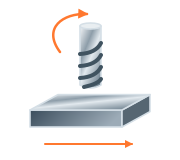
Spindle speed & table feed
Translate your tool supplier’s cutting data into RPM and feed. Use effective cutting diameter and effective teeth.
n = 1,000 × Vc / (π × D) vf = n × z × fz
Example inputs illustrate arithmetic. They are not recommended cutting conditions. Check chip thinning, engagement, reach and machine limits with your tooling data.
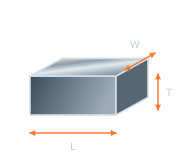
Estimate a solid rectangular blank using dimensions and density from your material specification.
Volume (cm³) = L × W × T / 1,000 Mass (kg) = L × W × T × density / 1,000,000
Density 2.7 is an example input, not a material selection. Excludes holes, pockets, extra machining allowance and packaging. Confirm actual grade, condition, stock dimensions and supplier density.
Calculate an ideal fresh batch from final volume and a supplier-specified concentration by volume.
Concentrate = final volume × % / 100 Water = final volume − concentrate
A fresh-batch volume calculation only. It does not correct an existing sump or convert a refractometer reading. Follow the product’s mixing instructions, safety data and concentration factor.
Drawing / exact conversion
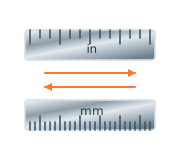
Inches ↔ millimetres
Check a length conversion before discussing a drawing or stock size.
1 in = 25.4 mm exactly
Converting a value does not change the drawing’s governing units, tolerance or precision.
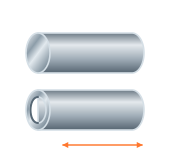
Use actual outside and inside diameters, not a nominal pipe designation. Enter zero inside diameter for solid bar. Leave density blank to keep mass unresolved.
Volume (cm³) = π × (OD² − ID²) × length / 4,000. Mass (kg) = volume (cm³) × density (g/cm³) / 1,000. Density entered in kg/m³ is divided by 1,000 first. Geometric wall thickness = (OD − ID) / 2.
Ideal constant circular section only. No allowance, kerf, eccentricity, dimensional tolerances, holes, coatings or packaging included. Wall thickness is geometry, not a strength rating. Quantity multiplies the entered blank; it does not optimize a cut list.
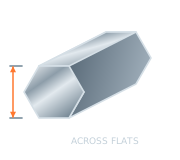
Enter the distance between two opposite parallel flats, not corner to corner. This tool assumes an ideal regular hexagon. Leave density blank if undecided.
Volume (cm³) = √3 × across-flats² × length / 2,000. Across corners = 2 × across flats / √3. Mass (kg) = volume (cm³) × density (g/cm³) / 1,000. Density entered in kg/m³ is divided by 1,000 first.
Excludes corner radii, stock tolerances, holes, allowance, kerf and packaging. Across-corners output describes ideal geometry, not a supplied-stock tolerance or a tooling clearance approval.
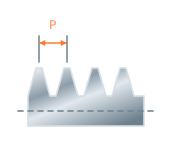
Translate spacing from your source without guessing a thread designation. The result is a unit relationship, not a matching-thread recommendation.
Pitch (mm) = 25.4 / TPI. TPI = 25.4 / pitch (mm). One inch is exactly 25.4 mm; repeating results are rounded for display.
Equal spacing alone does not establish matching thread form, diameter, taper, class or compatibility. No standard designation, drill diameter, tapping feed, engagement or strength is calculated. Keep the original drawing callout and units.
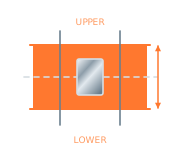
For a drawing showing ±0.05, enter −0.05 and +0.05. For +0.010/+0.030, enter +0.010 as the lower deviation and +0.030 as the upper deviation. These are arithmetic examples, not recommended tolerances. Read signs and units from the actual drawing; this tool does not interpret a geometric feature control frame.