The starting question
Dimension wall height and thickness together.
See the difference
Tall, slender section
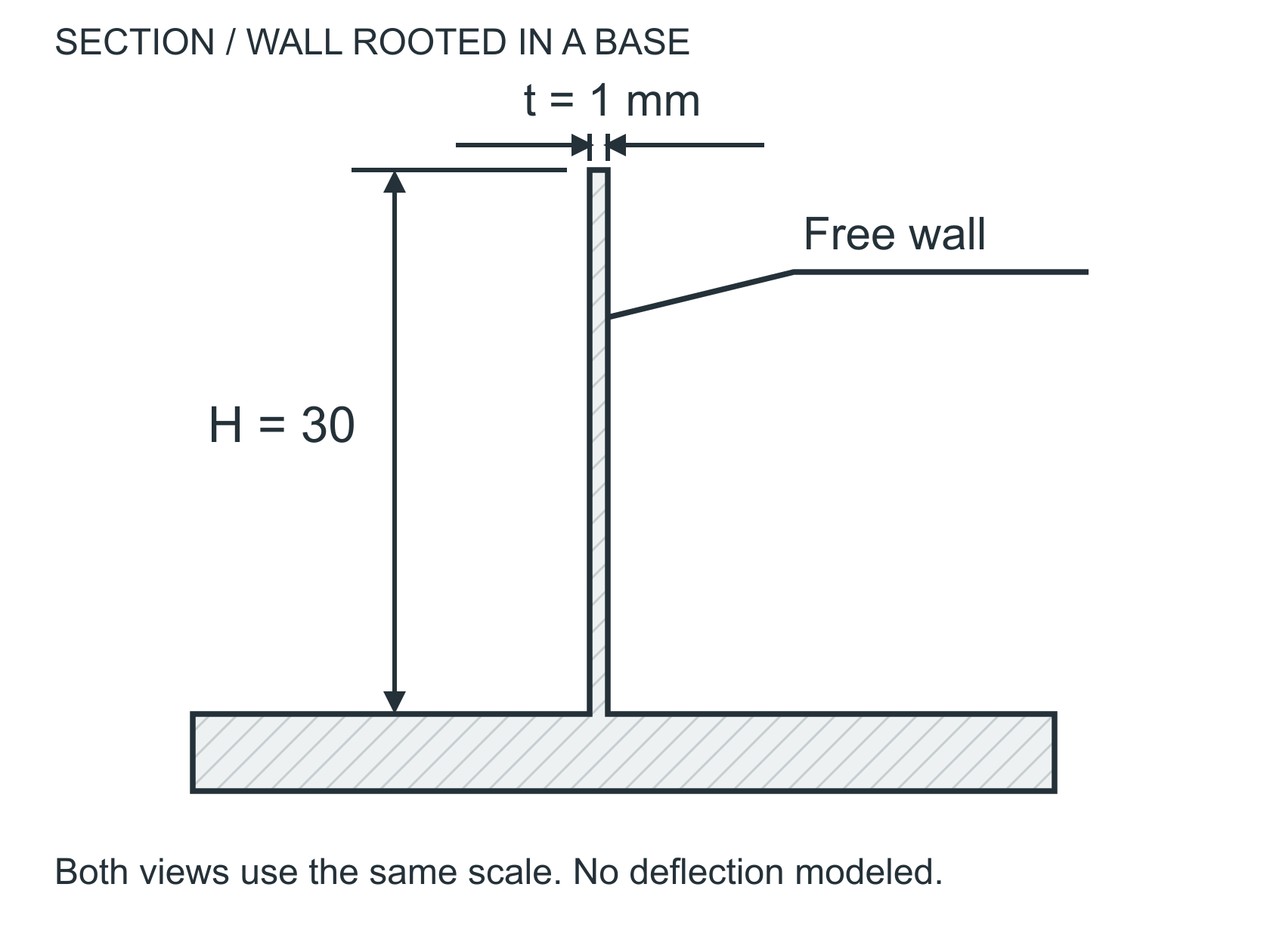
A long unsupported feature needs a workholding and cutting-force review. Thickness alone is not enough.
Shorter, thicker section
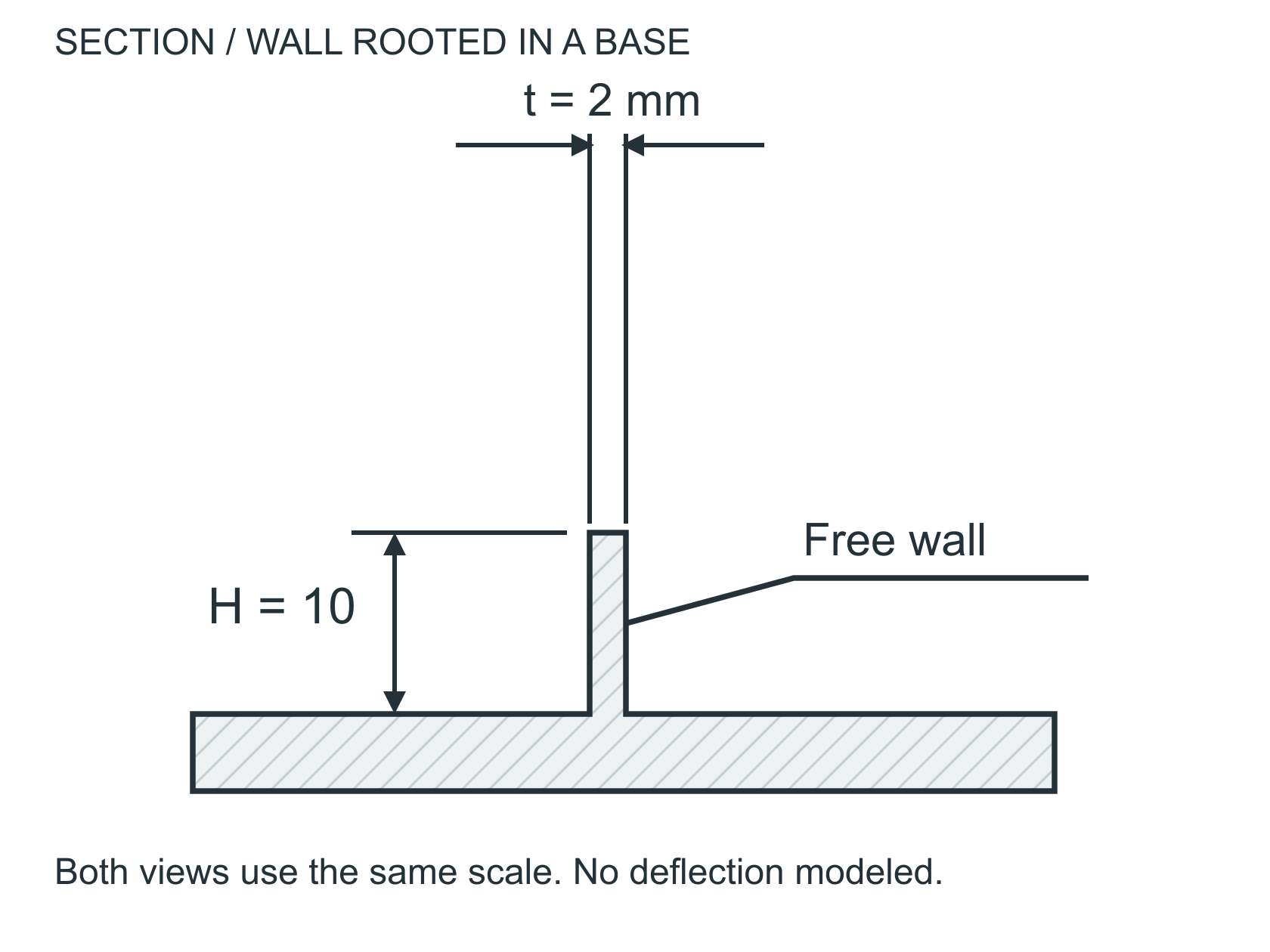
Change height, thickness or add support only where the design permits. Function still governs.
Geometry ratio = unsupported height / thickness
30 / 1 = 30 | 10 / 2 = 5A 30 mm high, 1 mm thick wall has H/t = 30. A 10 mm high, 2 mm thick wall has H/t = 5. These ratios describe geometry only; they are not pass/fail criteria or a calculated deflection.
H/t describes slenderness. It is not a stiffness calculation, a vibration prediction or a universal pass/fail limit.
For your own project
Which part do you need help with?
Start with what you know. Keep the undecided details open for discussion.
You bring
Your sketch, drawing or existing CAD, including known units.
We can help explore
Clearer geometry and the details still missing from the design.
Discuss next
Which dimensions are trusted, and which need review?
Support the feature
Consider a shorter unsupported span, a thicker wall or an allowed rib. Preserve required clearance and mass targets. Clamping access belongs in the review before stock removal.
Separate material families
A nominal thickness does not transfer unchanged between aluminum, stainless and plastics. Review alloy, temper or hardness, remaining section and stock condition.
Plastics need conditioning
Heat, moisture and stress relaxation can change dimensions. Specify measurement conditions where they matter, and review coolant compatibility and clamping pressure.
For PEEK, acetal, nylon and filled polymers, identify the exact grade and conditioning requirements. Filled grades can be abrasive; nylon moisture uptake can affect size. Do not treat all plastics as one material.
Bring this to the review
Your working checklist
Use these prompts to record open questions. Checking a box does not approve a design or manufacturing process. Selections last for this page visit.
References & further reading
References support the named topic; they do not certify a design, setup or product.
Planning guidance and illustrative examples. Confirm project-specific requirements with the responsible design, manufacturing and quality teams.
No paid placement or affiliate links in this guide.