The starting question
What would a useful model, drawing, assembly view or render help you decide?
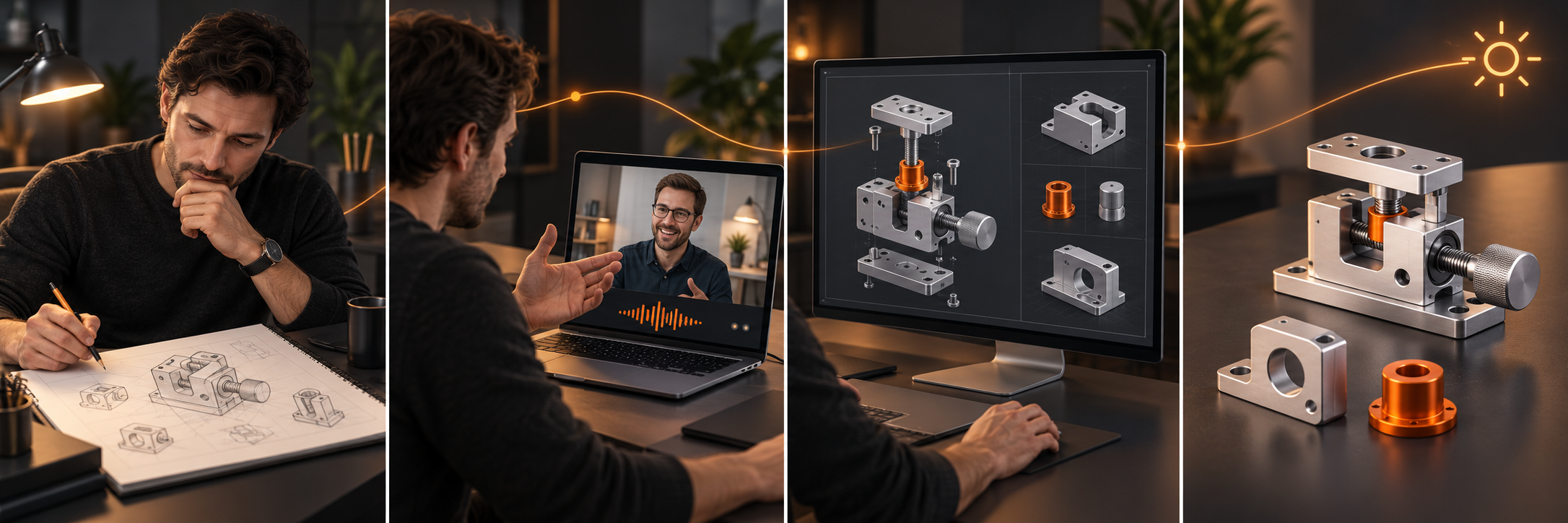
For your own project
Which part do you need help with?
Start with what you know. Keep the undecided details open for discussion.
You bring
An idea, a rough sketch or an example of the problem.
We can help explore
Possible shapes, features and a clearer concept to discuss.
Discuss next
What must it do, and which questions matter most?
Start with the design problem
If you searched for metal fabrication or a welder, first describe the part or assembly you want to create. Do you need help turning a sketch into CAD, defining how parts connect, changing an existing design, or preparing drawings for a fabrication review?
ProtoChat focuses on design services. Tell us which digital deliverables would help: a part model, assembly, drawing or render. Physical fabrication and supplier selection are separate items to clarify, rather than assumed outcomes of a CAD request.
Explain what local means for this project
Does location matter for measurement, an installation visit, pickup or delivery? A remote design review and a physical shop handoff can have different requirements. Record the location constraint without assuming a nearby supplier can perform every operation.
For the design conversation, identify what can be explained remotely and what would require measurements or inspection of an existing part. Do not guess dimensions from a photograph.
Bring the shape and the open choices
Provide the sketch, drawing or model revision you have, plus the dimensions and quantity you know. Identify bends, holes, welded connections or mating features that matter. Keep material, thickness, finish and unresolved dimensions open rather than guessing.
For bent sheet metal, ask the intended fabricator to review tooling and the flat pattern before production. Do not treat a generic bend allowance or K-factor as an approved process for your part.
Tell us which decisions the design should answer
For an assembly, describe which parts move, locate or fasten together. For a render, explain what you need to communicate visually. For a drawing, identify the intended recipient and which requirements are known.
You do not need to choose every technical detail before starting the conversation. Keep requirements, preferences and unknowns distinct so the concept and estimate reflect the work you actually need.
Review the concept before accepting detailed work
Use the initial conversation to clarify the brief and review the exact concept being discussed. Keep corrections and unresolved choices attached to that version.
Got a presentation coming up or a customer waiting for answers? Tell us which deliverable you need first and your deadline. We’ll confirm the proposed scope and timing before you commit to detailed work. A concept for discussion is not a released manufacturing design.
Bring this to the review
Your working checklist
Use these prompts to record open questions. Checking a box does not approve a design or manufacturing process. Selections last for this page visit.
Planning guidance and illustrative examples. Confirm project-specific requirements with the responsible design, manufacturing and quality teams.
No paid placement or affiliate links in this guide.